Journal

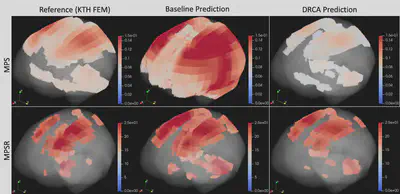
Local and Global Effects of Inertial Force Components Producing Brain Strain During Head Impacts

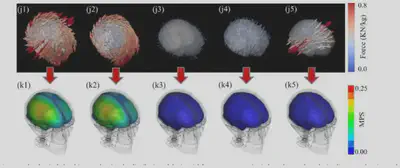
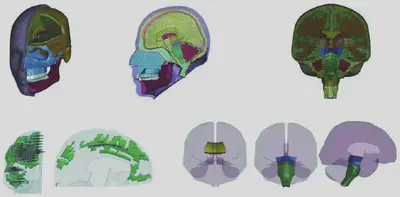
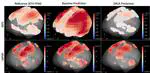
Inertial force components and corresponding brain strain distributions.

Abstract

Traumatic brain injury (TBI) is a brain dysfunction caused by an external mechanical force and is a leading cause of disability worldwide. In traumatic brain injury, the brain strain is driven by inertial force associated with head acceleration. We identified three distinct mechanisms by which inertial forces induce brain strain: the global rotation effect, the global translation effect, and the local force effect. The global rotation and translation effects arise from whole-brain movement relative to the skull, producing brain strain through shearing, pushing, and pulling, respectively. In contrast, the local force effect refers to the strain produced inside the brain by the local force without whole-brain movement. These effects correspond to different inertial force components: Euler force (angular acceleration), linear force (linear acceleration), and centrifugal force (angular velocity). In this study, we applied impact loading by each inertial force component independently to quantify their contributions and clarify the conditions under which Holbourn’s hypothesis applies. We found that 97% of the total MPS in American football impacts was produced by the Euler force. When head kinematics were extended to extreme scenarios such as aviation or high-impact accidents, both linear and centrifugal forces were also capable of producing significant brain strain. Independent kinematic thresholds were estimated, showing that most injurious head impacts consistently exceed angular acceleration thresholds, while corresponding linear accelerations and angular velocities remain below them.

Local and Global Effects of Inertial Force Components Producing Brain Strain During Head Impacts
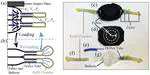
AI-based identification of head impact locations, speeds, and force based on head kinematics simulations

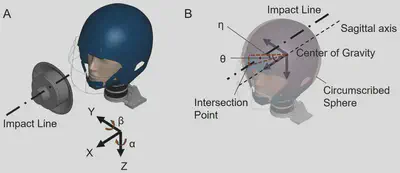
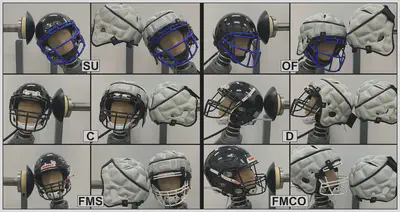
Head impact parameter identification from helmeted impact simulations.

Abstract

Objective: With the development of wearable sensors, head kinematics data have become widely available. However, key impact information—such as impact direction, speed, and force—which is crucial for helmet development, is still not directly measured. This study presents a deep learning model designed to accurately predict these head impact parameters from head kinematics during helmeted impacts. Methods: Leveraging a dataset of 16,000 simulated helmeted head impacts using the Riddell helmet finite element model, a Long Short-Term Memory (LSTM) network was implemented to process the head kinematics: linear accelerations and angular velocities. Results: In simulations, the model accurately predicted impact direction, speed, and the force profile with R² exceeding 70% for all tasks. Validation on 79 on-field impacts recorded by instrumented mouthguards and videos demonstrated that the model significantly outperformed traditional methods in identifying impact locations, achieving 79.7% accuracy compared to the previous highest of 49.4%. Conclusion: This work highlights the potential of deep learning to enhance helmet design and head impact sensing by recovering key impact parameters from wearable kinematic data. Future work should evaluate model performance across helmet types and sports, and apply transfer learning for broader applicability.

AI-based identification of head impact locations, speeds, and force based on head kinematics simulations
Differences between two maximal principal strain rate calculation schemes in traumatic brain analysis with in-vivo and in-silico datasets

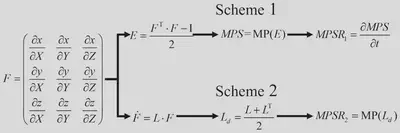
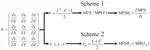
Comparison of two maximal principal strain rate calculation schemes.

Abstract

Brain deformation caused by a head impact leads to traumatic brain injury (TBI). The maximum principal strain (MPS) was used to measure the extent of brain deformation and predict injury, and recent evidence has indicated that incorporating the maximum principal strain rate (MPSR) and the product of MPS and MPSR, denoted as MPS × SR, enhances the accuracy of TBI prediction. However, ambiguities have arisen about the calculation of MPSR. Two schemes have been utilized: one is to use the time derivative of MPS (MPSR1), and another is to use the first eigenvalue of the strain rate tensor (MPSR2). To quantify the discrepancies between these two methodologies, we compared them across eight in-vivo and one in-silico head impact datasets and found that 95MPSR1 was slightly larger than 95MPSR2 and 95MPS × SR1 was 4.85% larger than 95MPS × SR2 on average. Across every element in all head impacts, the average MPSR1 was 12.73% smaller than MPSR2, and MPS × SR1 was 11.95% smaller than MPSR2. Logistic regression models trained to predict TBI showed no significant difference in predictability between the two schemes. The consequence of misuse of MPSR and MPS × SR thresholds was also examined, showing false decision rates around 1%, suggesting that the two methodologies are not significantly different in detecting TBI.

Differences between two maximal principal strain rate calculation schemes in traumatic brain analysis with in-vivo and in-silico datasets
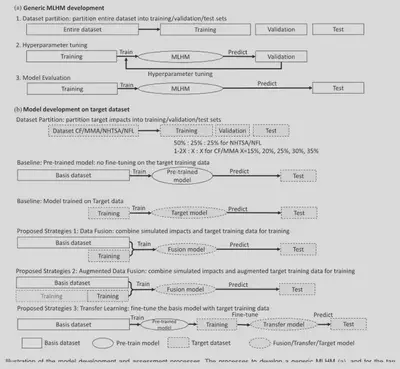
Brain Deformation Estimation With Transfer Learning for Head Impact Datasets Across Impact Types

Transfer learning workflow for machine-learning head models.

Abstract

Objective: The machine-learning head model (MLHM) to accelerate the calculation of brain strain and strain rate, which are the predictors for traumatic brain injury (TBI), but the model accuracy was found to decrease sharply when the training/test datasets were from different head impacts types (i.e., car crash, college football), which limits the applicability of MLHMs to different types of head impacts and sports. Particularly, small sizes of target dataset for specific impact types with tens of impacts may not be enough to train an accurate impact-type-specific MLHM. Methods: To overcome this, we propose data fusion and transfer learning to develop a series of MLHMs to predict the maximum principal strain (MPS) and maximum principal strain rate (MPSR). Results: The strategies were tested on American football (338), mixed martial arts (457), reconstructed car crash (48) and reconstructed American football (36) and we found that the MLHMs developed with transfer learning are significantly more accurate in estimating MPS and MPSR than other models, with a mean absolute error (MAE) smaller than 0.03 in predicting MPS and smaller than 7 s⁻¹ in predicting MPSR on all target impact datasets. High performance in concussion detection was observed based on the MPS and MPSR estimated by the transfer-learning-based models. Conclusion: The MLHMs can be applied to various head impact types for rapidly and accurately calculating brain strain and strain rate. Significance: This study enables developing MLHMs for the head impact type with limited availability of data, and will accelerate the applications of MLHMs.

Brain Deformation Estimation With Transfer Learning for Head Impact Datasets Across Impact Types