Journal

Brain strain rate response: Addressing computational ambiguity and experimental data for model validation

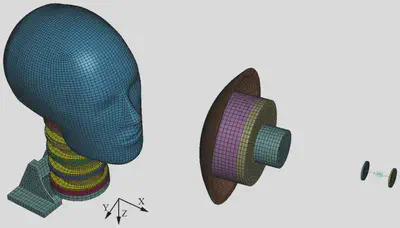
Brain strain rate response under experimental and computational loading conditions.

Abstract

Traumatic brain injury (TBI) is an alarming global public health issue with high morbidity and mortality rates. Although the causal link between external insults and consequent brain injury remains largely elusive, both strain and strain rate are generally recognized as crucial factors for TBI onsets. With respect to the flourishment of strain-based investigation, ambiguity and inconsistency are noted in the scheme for strain rate calculation within the TBI research community. Furthermore, there is no experimental data that can be used to validate the strain rate responses of finite element (FE) models of the human brain. The current work presented a theoretical clarification of two commonly used strain rate computational schemes: the strain rate was either calculated as the time derivative of strain or derived from the rate of deformation tensor. To further substantiate the theoretical disparity, these two schemes were respectively implemented to estimate the strain rate responses from a previous-published cadaveric experiment and an FE head model secondary to a concussive impact. The results clearly showed scheme-dependent responses, both in the experimentally determined principal strain rate and model-derived principal and tract-oriented strain rates. The results highlight that cross-scheme comparison of strain rate responses is inappropriate, and the utilized strain rate computational scheme needs to be reported in future studies. The newly calculated experimental strain rate curves in the supplementary material can be used for strain rate validation of FE head models. Statement of significance: - Delineates a theoretical clarification of two algorithms for strain rate computation. - Highlights the strain rate responses directly depends on the computational schemes. - Presents experimental strain rate curves, serving as references for strain rate validation of finite element head models. 1.

Brain strain rate response: Addressing computational ambiguity and experimental data for model validation
Translational models of mild traumatic brain injury tissue biomechanics

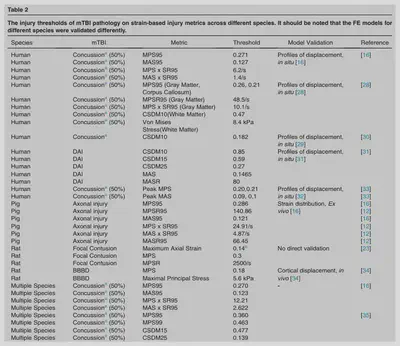
Comparison of mTBI pathology thresholds across translational models.

Abstract

T raumatic brain injury (TBI) is a global health concern. Mild TBI (mTBI) which accounts for the majority of TBI cases, is hard to detect since often the imaging is normal but can still cause brain damage and long-term sequelae. Physiologically, acute primary damage to the brain is thought to be caused by tissue deformation from the inertial movement of the brain after rapid head rotation. Respecting tissue biomechanics, animal models are often used to understand the pathophysiology of mTBI. We have reviewed the literature focusing on connecting biome- chanics with mTBI pathologies at the tissue scale using neuroimaging, neurobehavioral tests, and pathologies across species, particularly studies using strain and strain rate. These studies have found strain and strain rate predict mTBI pathol- ogy and strain is generalizable across species, including small animals, large animals, and humans. We propose that re- searchers can leverage tissue-level strain and strain rate to bridge biomechanics and mTBI pathology . Addresses 1 Department of Bioengineering, Stanford University, Stanford, CA, USA 2 Wallace H. Coulter Department of Biomedical Engineering, Georgia Institute of T echnology and Emory University, Atlanta, GA, USA 3 Department of Radiology, Stanford University, Stanford, CA, USA 4 Department of Neurosurgery , Duke University, Durham, NC, USA

Translational models of mild traumatic brain injury tissue biomechanics
Toward a Comprehensive Delineation of White Matter Tract-Related Deformation

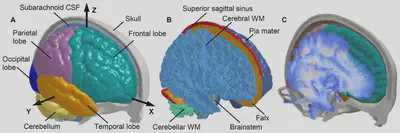
Finite element head model and tract-related deformation components.

Abstract

Finite element (FE) models of the human head are valuable instruments to explore the mechanobiological pathway from external loading, localized brain response, and resultant injury risks. The injury predictability of these models depends on the use of effective criteria as injury predictors. The FE-derived normal defor- mation along white matter (WM) fiber tracts (i.e., tract-oriented strain) recently has been suggested as an appropriate predictor for axonal injury. However, the tract-oriented strain only represents a partial depiction of the WM fiber tract deformation. A comprehensive delineation of tract-related deformation may improve the injury predictability of the FE head model by delivering new tract-related criteria as injury predictors. Thus, the present study performed a theoretical strain analysis to comprehensively characterize the WM fiber tract deformation by relating the strain tensor of the WM element to its embedded fiber tract. Three new tract-related strains with exact analytical solutions were proposed, measuring the normal defor- mation perpendicular to the fiber tracts (i.e., tract-perpendicular strain), and shear deformation along and perpendicular to the fiber tracts (i.e., axial-shear strain and lateral-shear strain, respectively). The injury pre- dictability of these three newly proposed strain peaks along with the previously used tract-oriented strain peak and maximum principal strain (MPS) were evaluated by simulating 151 impacts with known outcome (concussion or non-concussion). The results preliminarily showed that four tract-related strain peaks exhibited superior performance than MPS in discriminating concussion and non-concussion cases. This study presents a comprehensive quantification of WM tract-related deformation and advocates the use of orientation-dependent strains as criteria for injury prediction, which may ultimately contribute to an ad- vanced mechanobiological understanding and enhanced computational predictability of brain injury.

Toward a Comprehensive Delineation of White Matter Tract-Related Deformation