Brain Deformation

Brain Deformation Estimation With Transfer Learning for Head Impact Datasets Across Impact Types

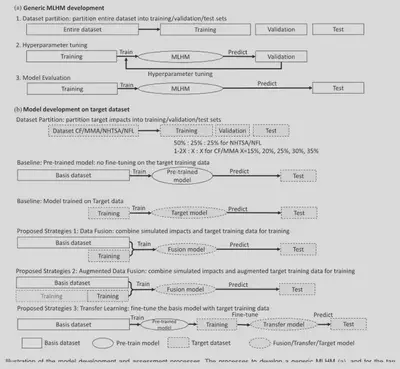
Transfer learning workflow for machine-learning head models.

Abstract

Objective: The machine-learning head model (MLHM) to accelerate the calculation of brain strain and strain rate, which are the predictors for traumatic brain injury (TBI), but the model accuracy was found to decrease sharply when the training/test datasets were from different head impacts types (i.e., car crash, college football), which limits the applicability of MLHMs to different types of head impacts and sports. Particularly, small sizes of target dataset for specific impact types with tens of impacts may not be enough to train an accurate impact-type-specific MLHM. Methods: To overcome this, we propose data fusion and transfer learning to develop a series of MLHMs to predict the maximum principal strain (MPS) and maximum principal strain rate (MPSR). Results: The strategies were tested on American football (338), mixed martial arts (457), reconstructed car crash (48) and reconstructed American football (36) and we found that the MLHMs developed with transfer learning are significantly more accurate in estimating MPS and MPSR than other models, with a mean absolute error (MAE) smaller than 0.03 in predicting MPS and smaller than 7 s⁻¹ in predicting MPSR on all target impact datasets. High performance in concussion detection was observed based on the MPS and MPSR estimated by the transfer-learning-based models. Conclusion: The MLHMs can be applied to various head impact types for rapidly and accurately calculating brain strain and strain rate. Significance: This study enables developing MLHMs for the head impact type with limited availability of data, and will accelerate the applications of MLHMs.

Brain Deformation Estimation With Transfer Learning for Head Impact Datasets Across Impact Types
Toward a Comprehensive Delineation of White Matter Tract-Related Deformation

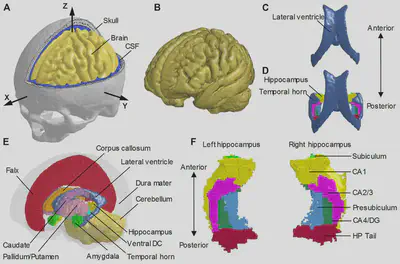
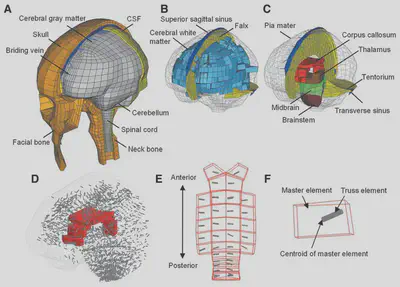
Finite element head model and tract-related deformation components.

Abstract

Finite element (FE) models of the human head are valuable instruments to explore the mechanobiological pathway from external loading, localized brain response, and resultant injury risks. The injury predictability of these models depends on the use of effective criteria as injury predictors. The FE-derived normal defor- mation along white matter (WM) fiber tracts (i.e., tract-oriented strain) recently has been suggested as an appropriate predictor for axonal injury. However, the tract-oriented strain only represents a partial depiction of the WM fiber tract deformation. A comprehensive delineation of tract-related deformation may improve the injury predictability of the FE head model by delivering new tract-related criteria as injury predictors. Thus, the present study performed a theoretical strain analysis to comprehensively characterize the WM fiber tract deformation by relating the strain tensor of the WM element to its embedded fiber tract. Three new tract-related strains with exact analytical solutions were proposed, measuring the normal defor- mation perpendicular to the fiber tracts (i.e., tract-perpendicular strain), and shear deformation along and perpendicular to the fiber tracts (i.e., axial-shear strain and lateral-shear strain, respectively). The injury pre- dictability of these three newly proposed strain peaks along with the previously used tract-oriented strain peak and maximum principal strain (MPS) were evaluated by simulating 151 impacts with known outcome (concussion or non-concussion). The results preliminarily showed that four tract-related strain peaks exhibited superior performance than MPS in discriminating concussion and non-concussion cases. This study presents a comprehensive quantification of WM tract-related deformation and advocates the use of orientation-dependent strains as criteria for injury prediction, which may ultimately contribute to an ad- vanced mechanobiological understanding and enhanced computational predictability of brain injury.

Toward a Comprehensive Delineation of White Matter Tract-Related Deformation