Head Impact

Local and Global Effects of Inertial Force Components Producing Brain Strain During Head Impacts

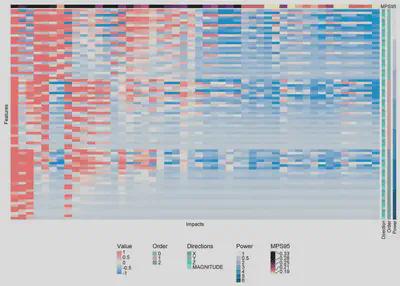
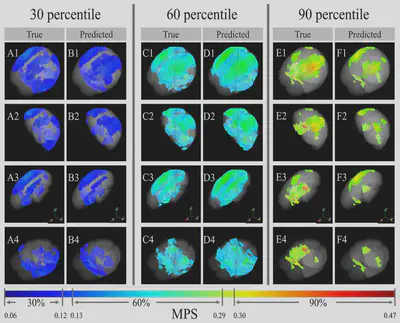
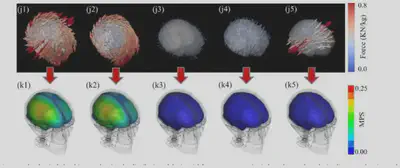
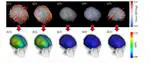
Inertial force components and corresponding brain strain distributions.

Abstract

Traumatic brain injury (TBI) is a brain dysfunction caused by an external mechanical force and is a leading cause of disability worldwide. In traumatic brain injury, the brain strain is driven by inertial force associated with head acceleration. We identified three distinct mechanisms by which inertial forces induce brain strain: the global rotation effect, the global translation effect, and the local force effect. The global rotation and translation effects arise from whole-brain movement relative to the skull, producing brain strain through shearing, pushing, and pulling, respectively. In contrast, the local force effect refers to the strain produced inside the brain by the local force without whole-brain movement. These effects correspond to different inertial force components: Euler force (angular acceleration), linear force (linear acceleration), and centrifugal force (angular velocity). In this study, we applied impact loading by each inertial force component independently to quantify their contributions and clarify the conditions under which Holbourn’s hypothesis applies. We found that 97% of the total MPS in American football impacts was produced by the Euler force. When head kinematics were extended to extreme scenarios such as aviation or high-impact accidents, both linear and centrifugal forces were also capable of producing significant brain strain. Independent kinematic thresholds were estimated, showing that most injurious head impacts consistently exceed angular acceleration thresholds, while corresponding linear accelerations and angular velocities remain below them.
Local and Global Effects of Inertial Force Components Producing Brain Strain During Head Impacts
AI-based identification of head impact locations, speeds, and force based on head kinematics simulations

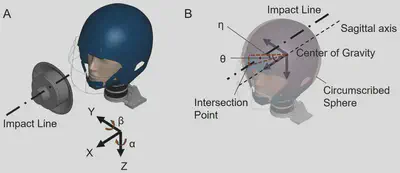
Head impact parameter identification from helmeted impact simulations.

Abstract

Objective: With the development of wearable sensors, head kinematics data have become widely available. However, key impact information—such as impact direction, speed, and force—which is crucial for helmet development, is still not directly measured. This study presents a deep learning model designed to accurately predict these head impact parameters from head kinematics during helmeted impacts. Methods: Leveraging a dataset of 16,000 simulated helmeted head impacts using the Riddell helmet finite element model, a Long Short-Term Memory (LSTM) network was implemented to process the head kinematics: linear accelerations and angular velocities. Results: In simulations, the model accurately predicted impact direction, speed, and the force profile with R² exceeding 70% for all tasks. Validation on 79 on-field impacts recorded by instrumented mouthguards and videos demonstrated that the model significantly outperformed traditional methods in identifying impact locations, achieving 79.7% accuracy compared to the previous highest of 49.4%. Conclusion: This work highlights the potential of deep learning to enhance helmet design and head impact sensing by recovering key impact parameters from wearable kinematic data. Future work should evaluate model performance across helmet types and sports, and apply transfer learning for broader applicability.

AI-based identification of head impact locations, speeds, and force based on head kinematics simulations